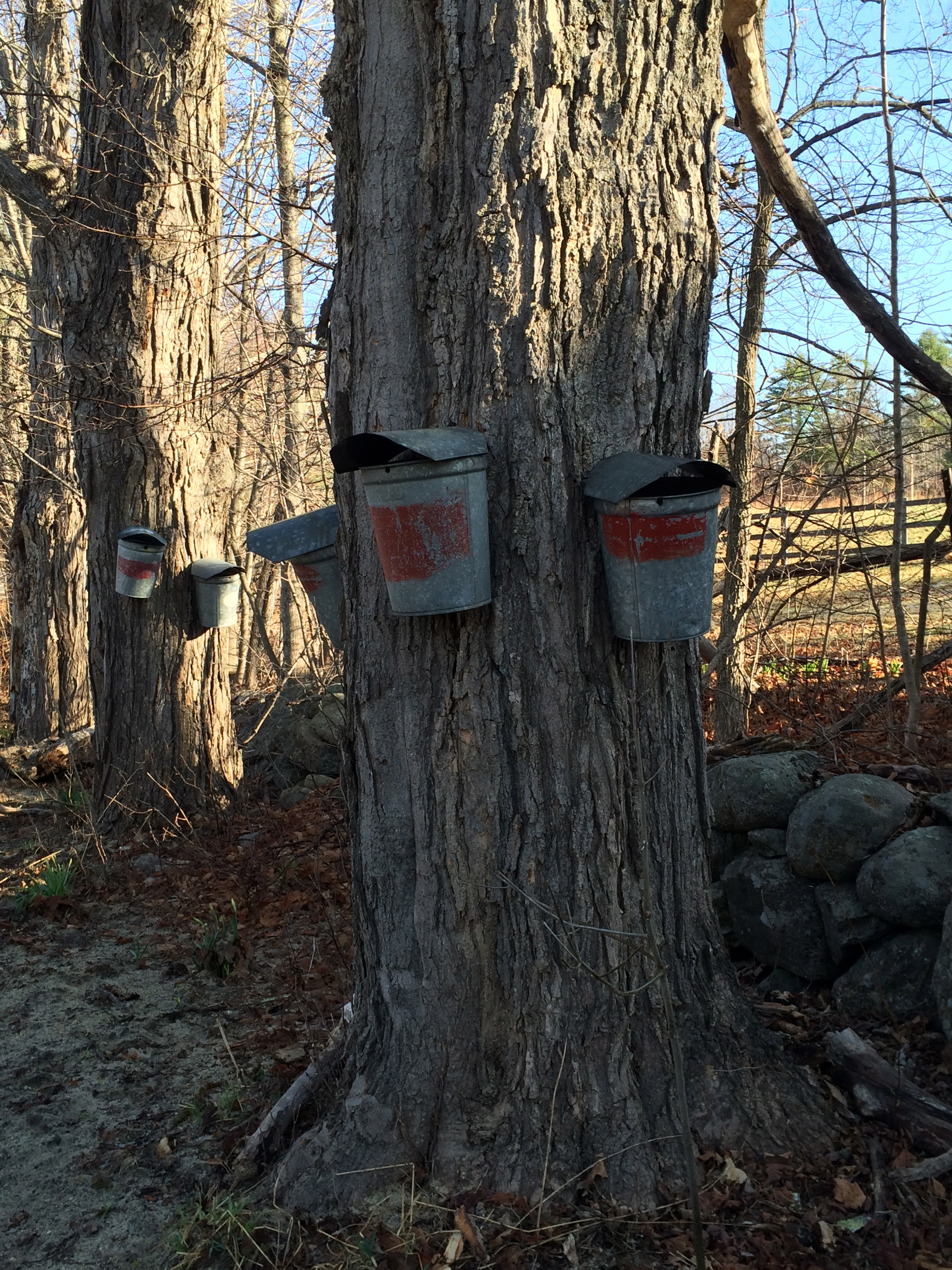
Maple sap pails – a welcome sign of spring.
Sugaring season in NH runs from roughly mid-February to mid-April, depending on the weather. Below freezing nights and warm sunny days (generally up to 45 degrees F) create the pressure needed for a good harvest, as the sap runs best under these conditions.
Each year, our friends at Stoneridge Farm include a bottle of eagerly anticipated, fresh maple syrup in one of their weekly CSA shares. The long wait through the winter makes the first bottle of the season even more precious. A recent visit to the sugar house was an interesting learning experience, and offered an in depth view of the process:
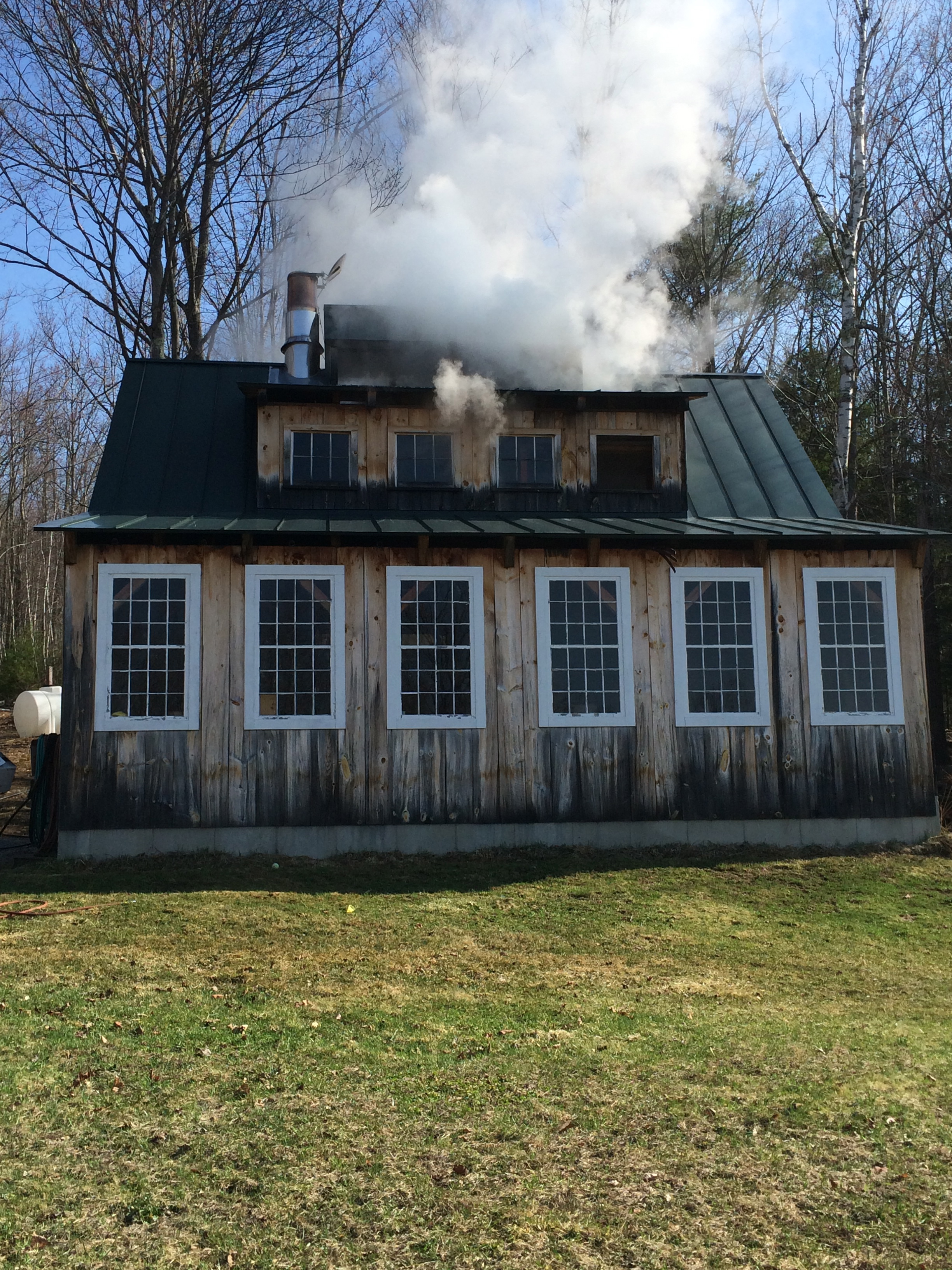
The sugar house
Sap is collected and boiled down in this wood fired evaporator:
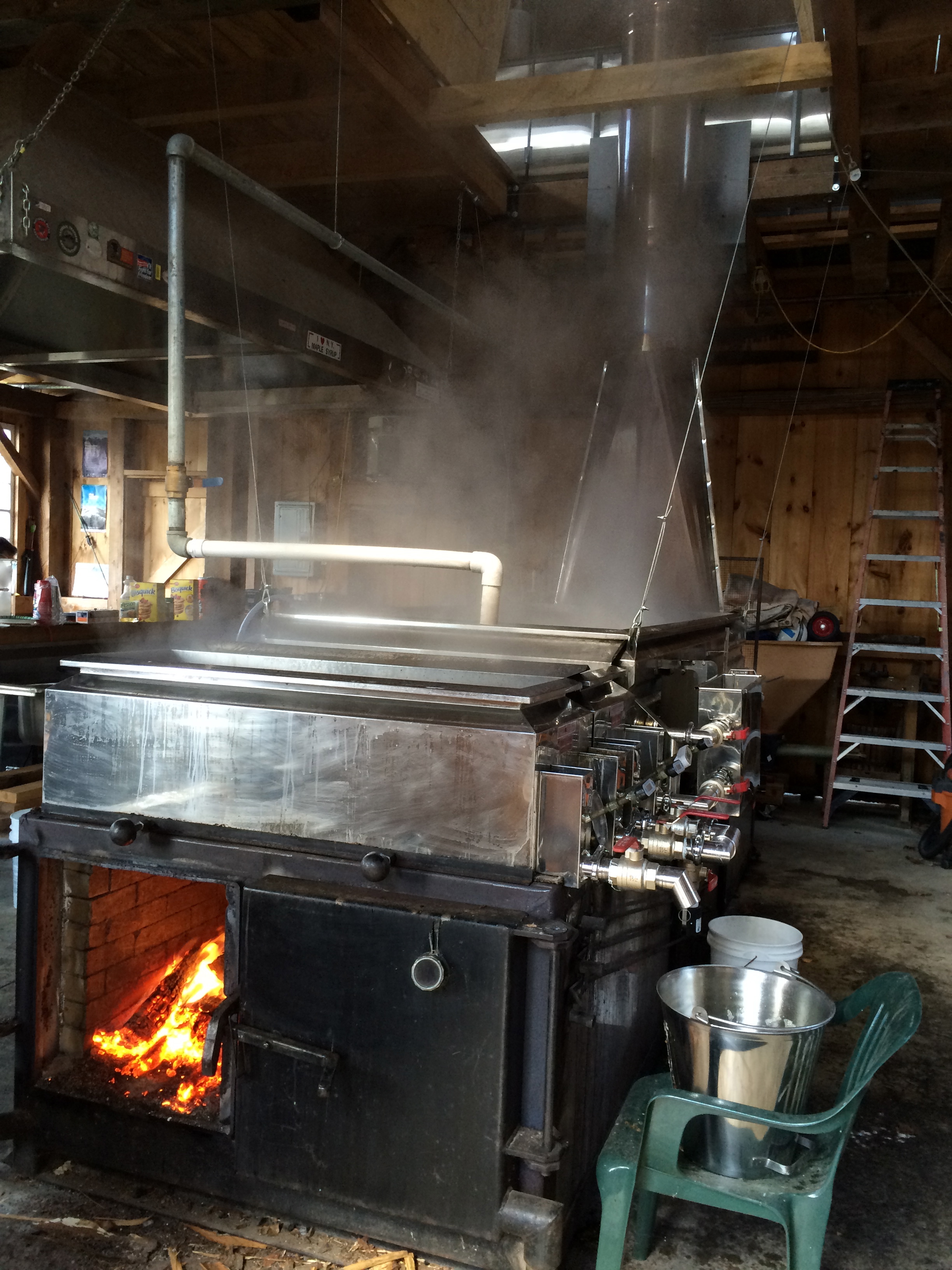
Roughly 200 gallons of sap are boiled off per hour.
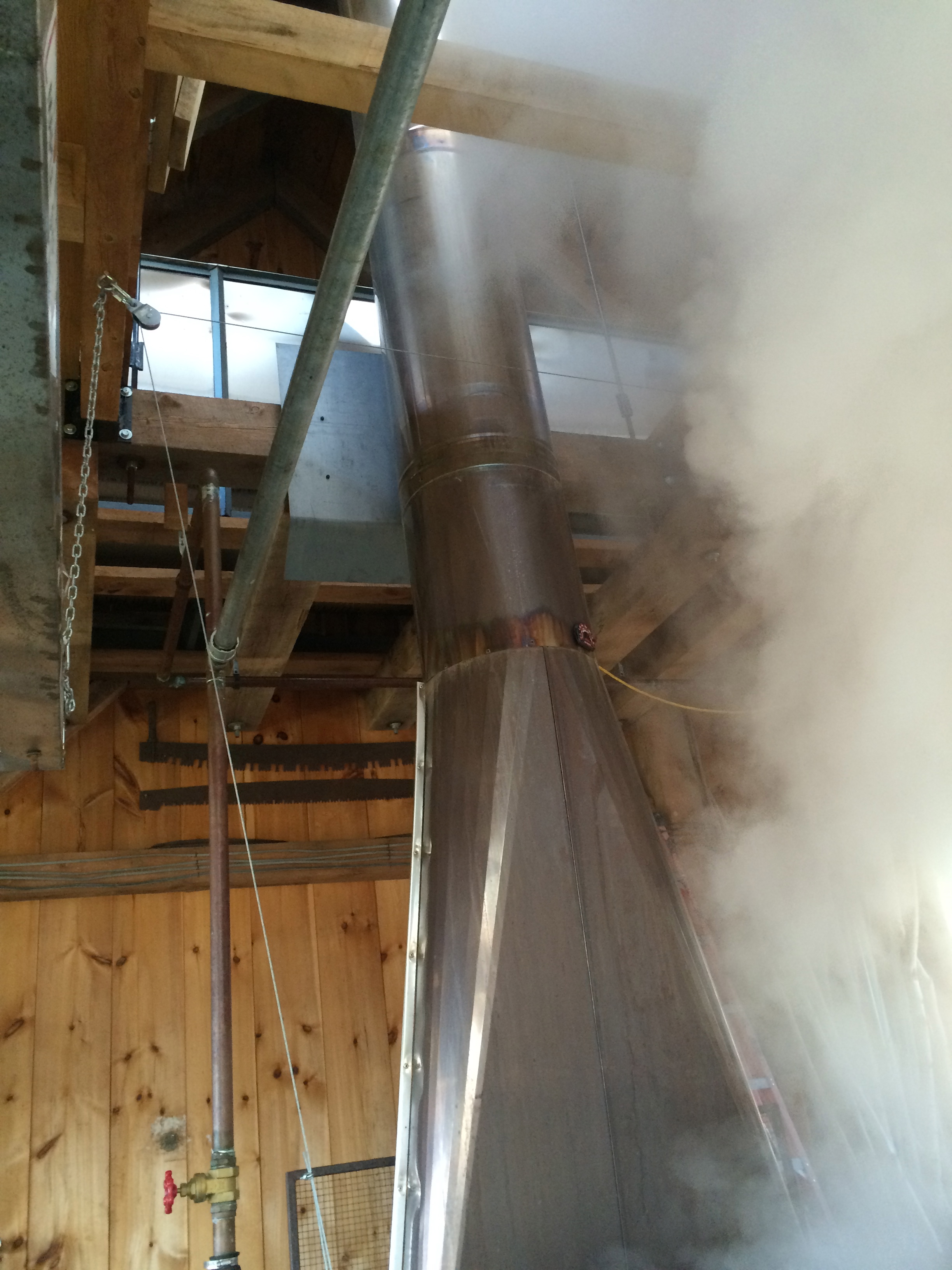
This particular tank holds up to 1,000 gallons.

Steam rising from the evaporator pan
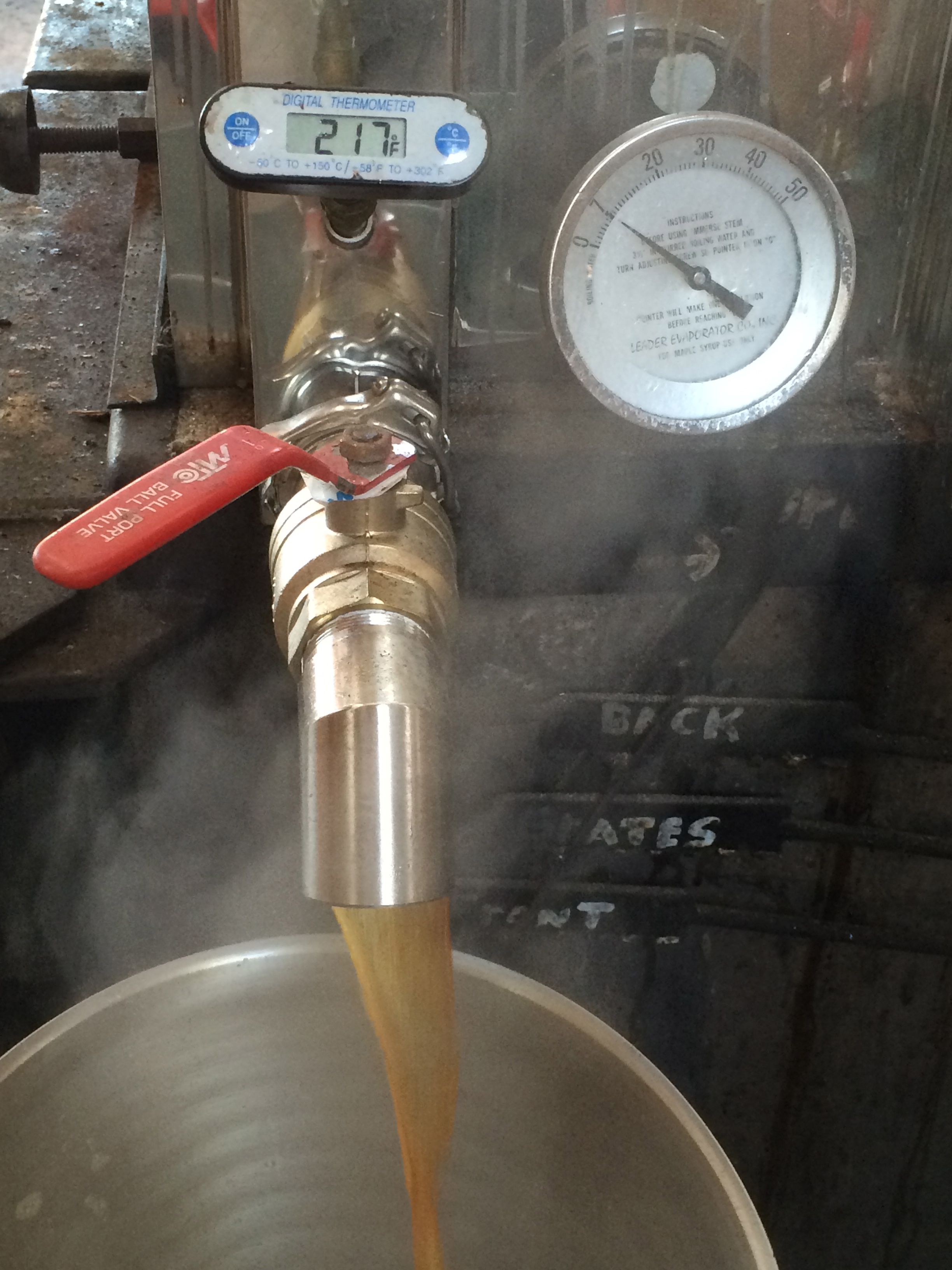
After water and other sediment is boiled off, the sap is concentrated until it reaches the proper density:
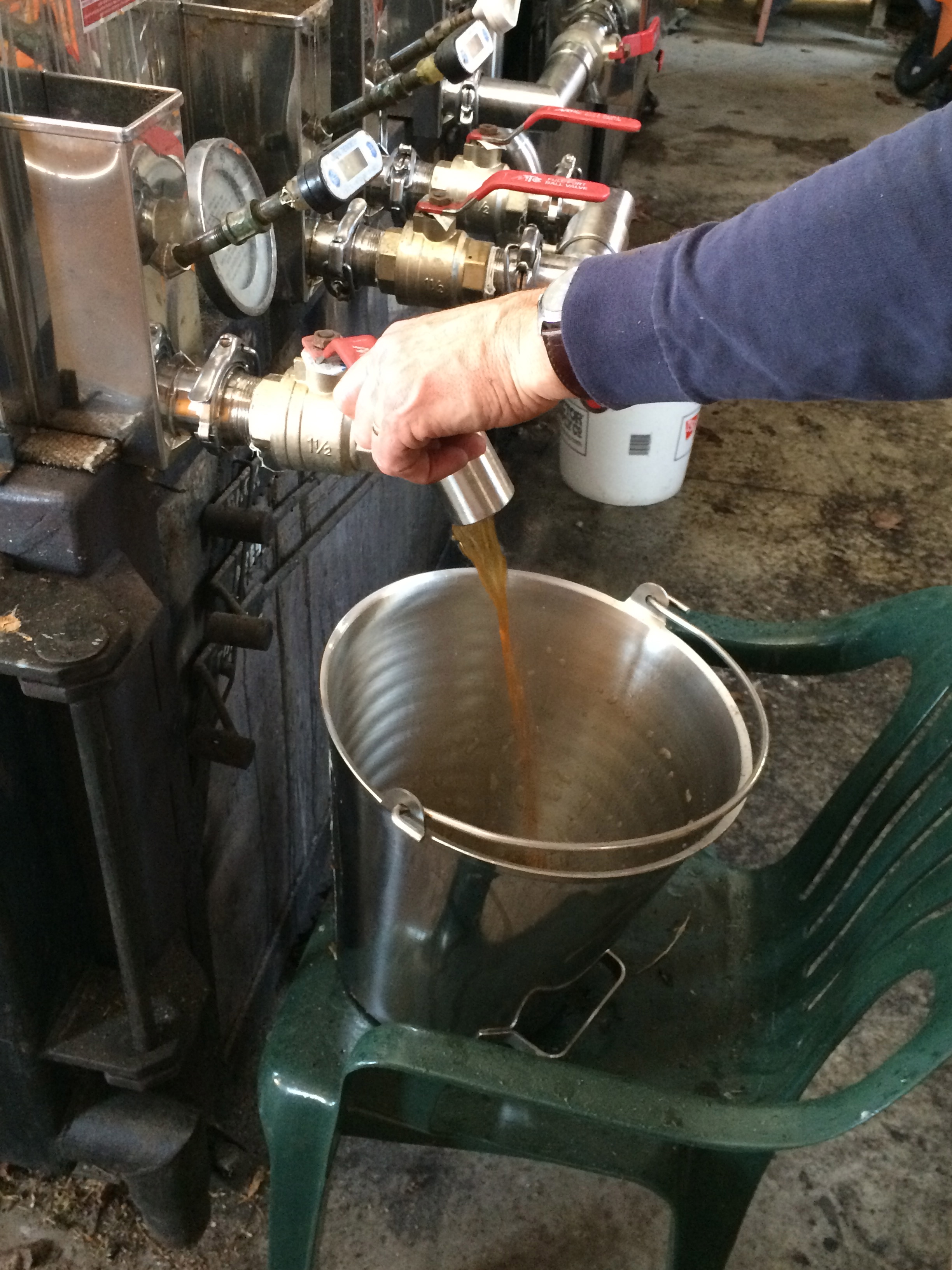
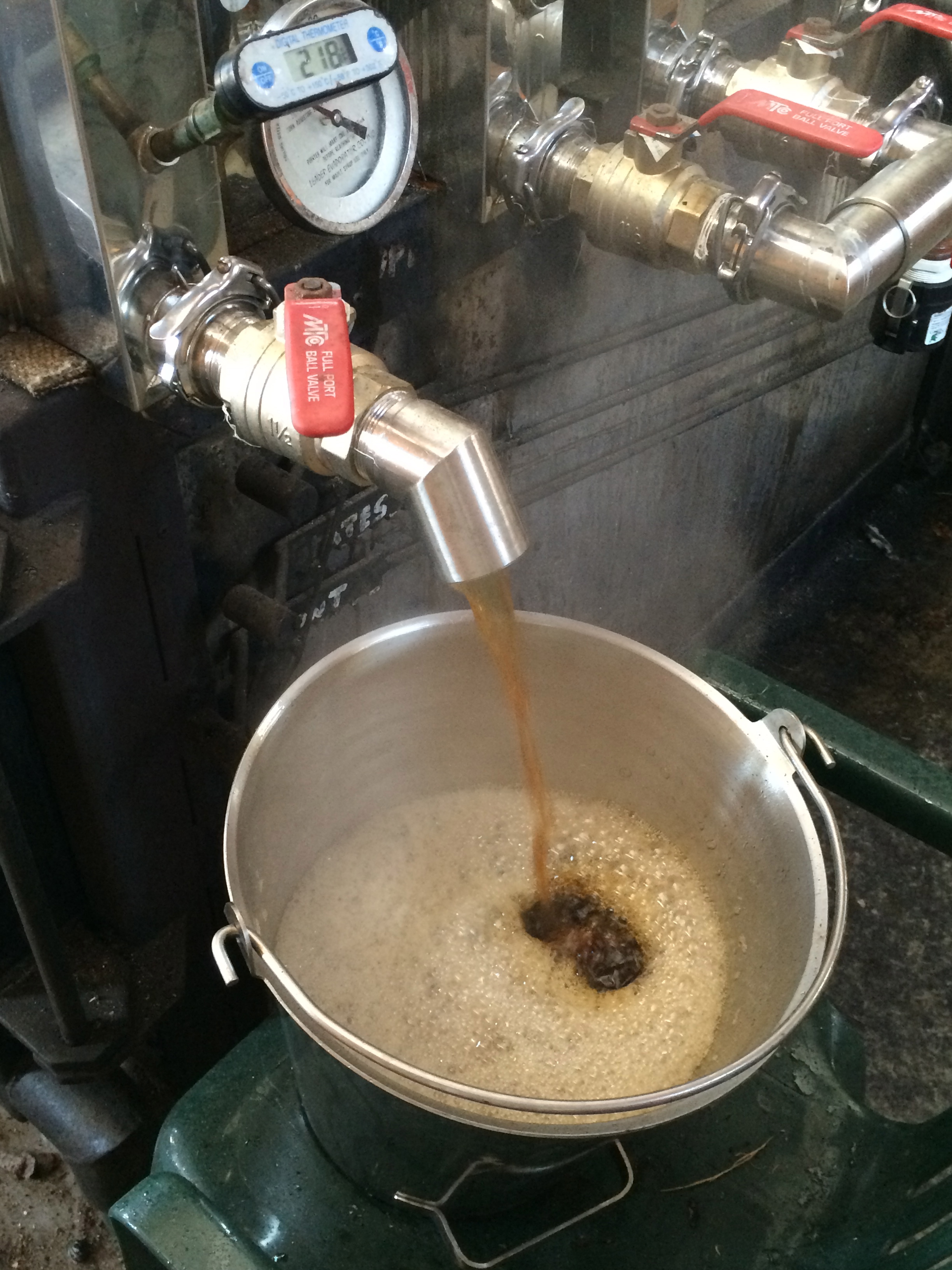
The syrup is ready at 7 degrees above boiling point, which varies daily depending on weather and atmospheric pressure.
Transferring to a finishing pan to fine tune sugar content:
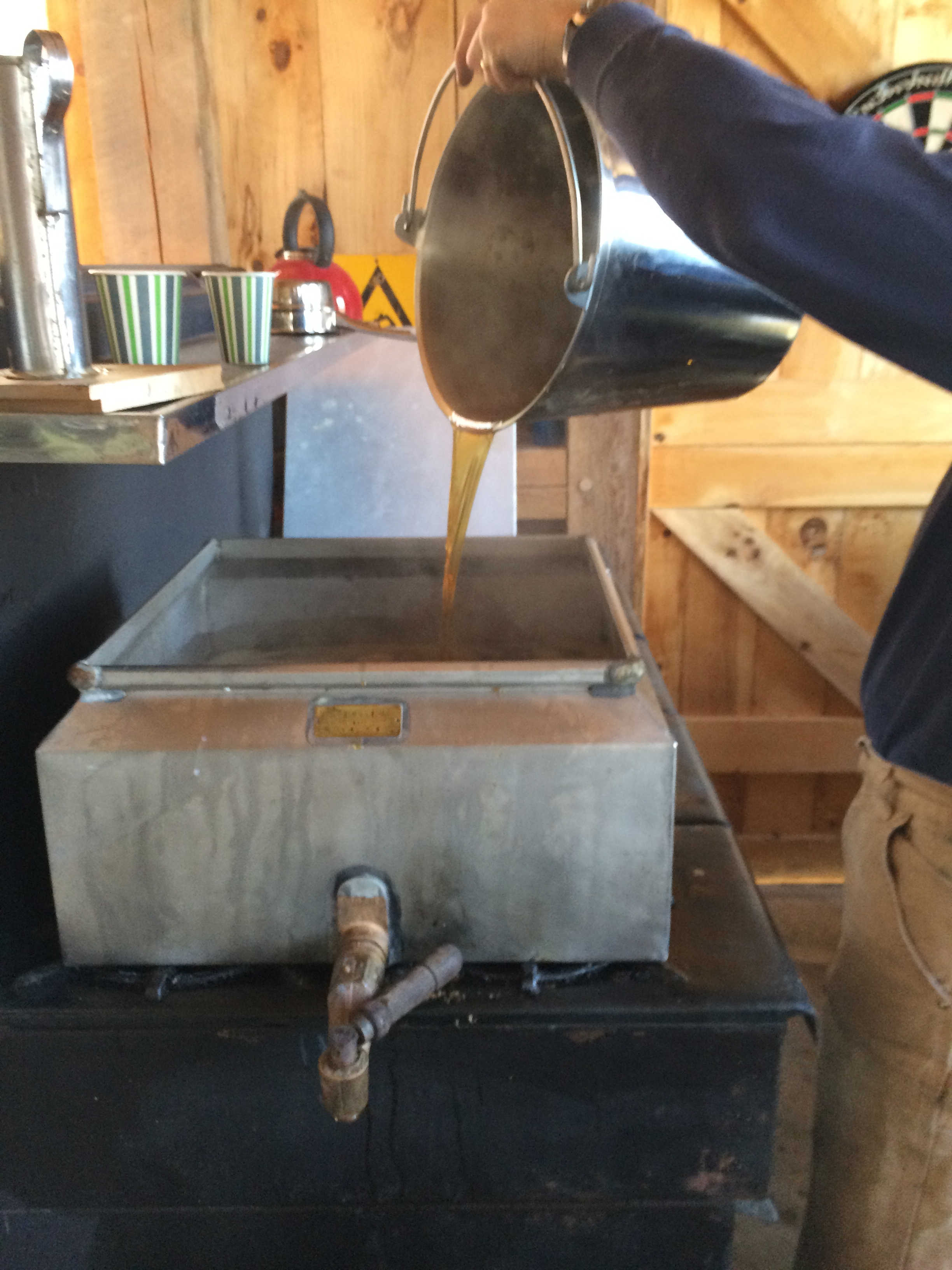
Finishing pan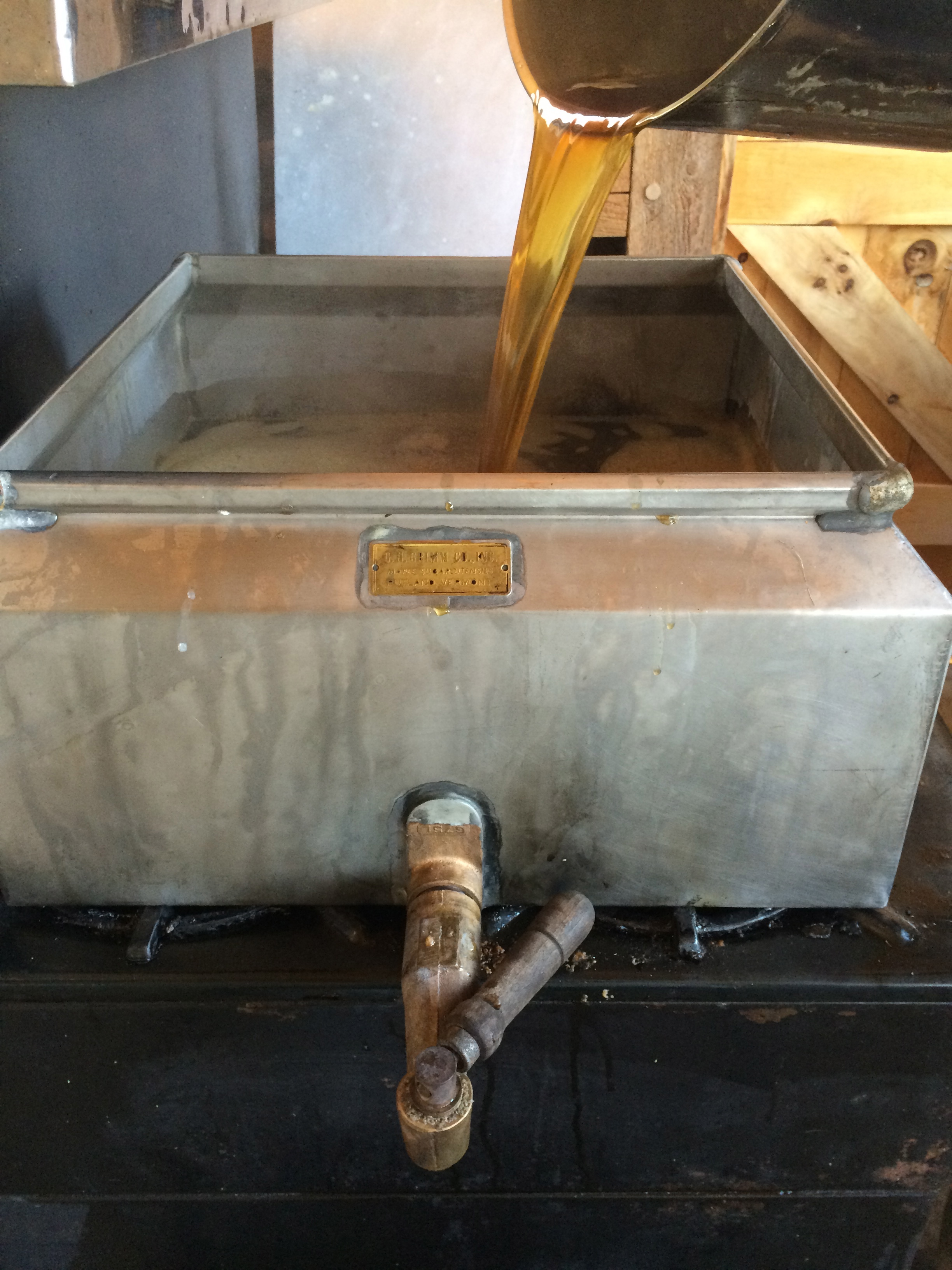
A Baume (B°, Bé°)/Brix (°Bx) hydrometer is used to determine sugar content and density:
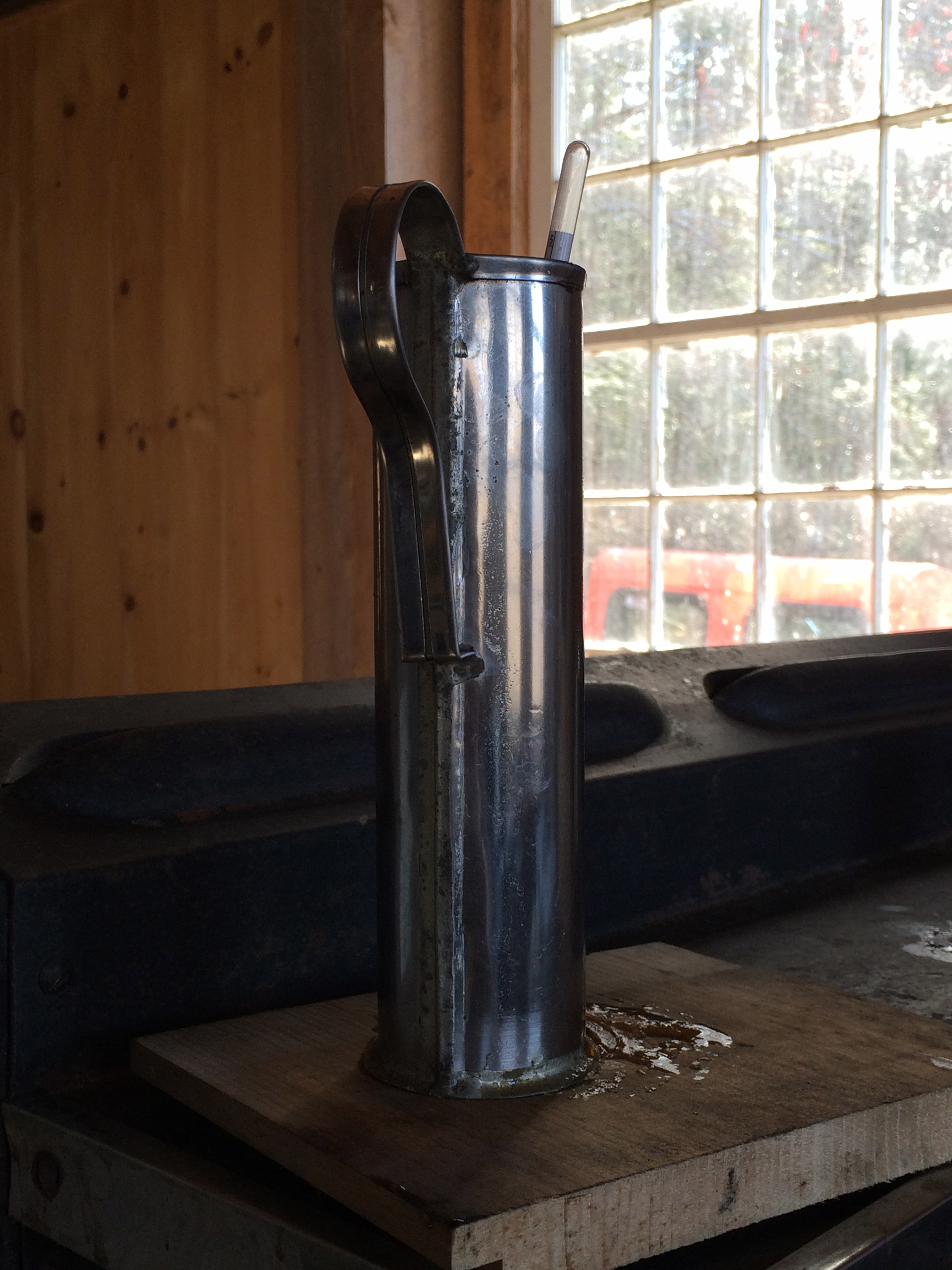
Brix measures the sugar content of an aqueous solution while Baume measures its density.
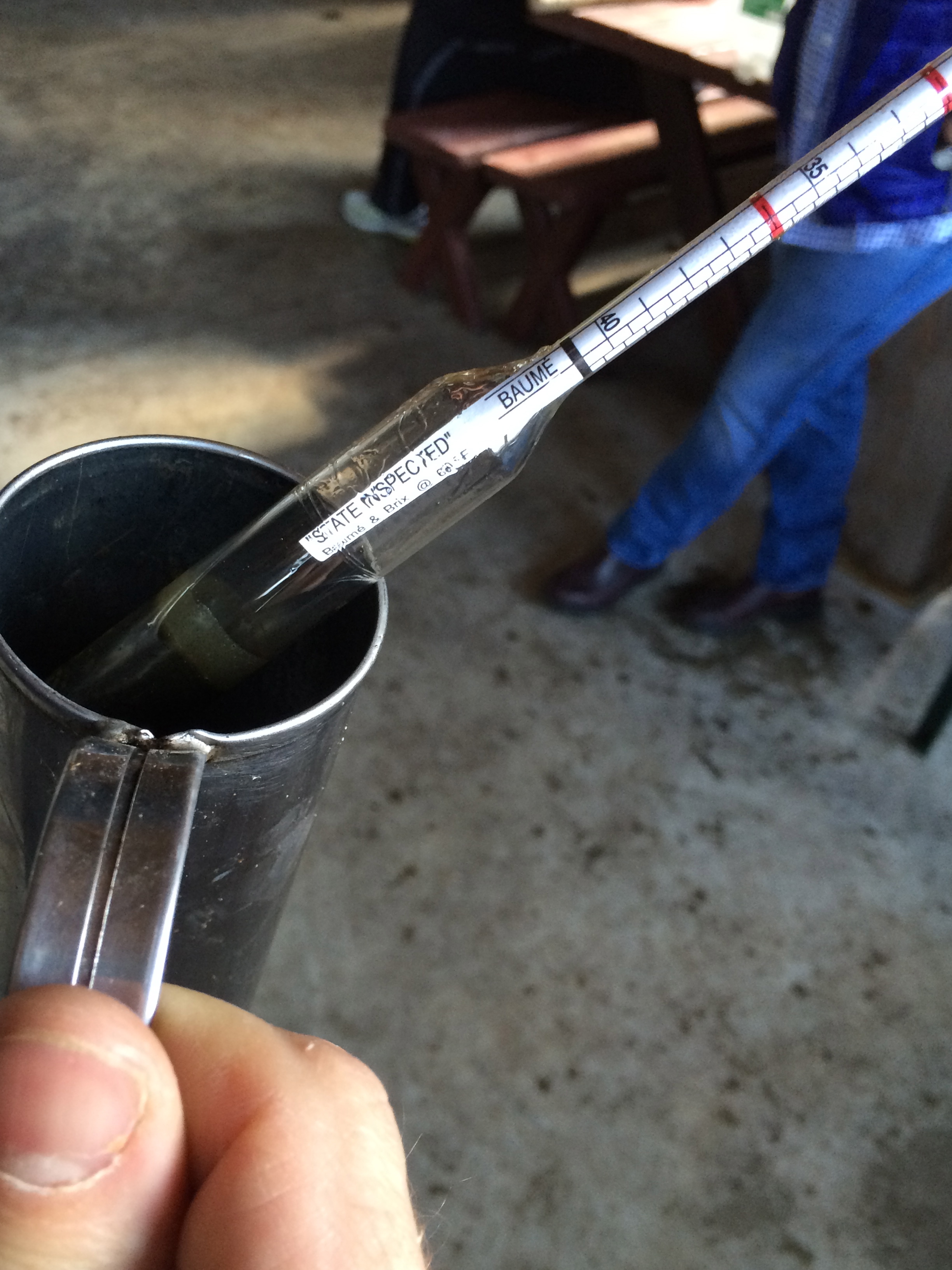
Checking a batch sample
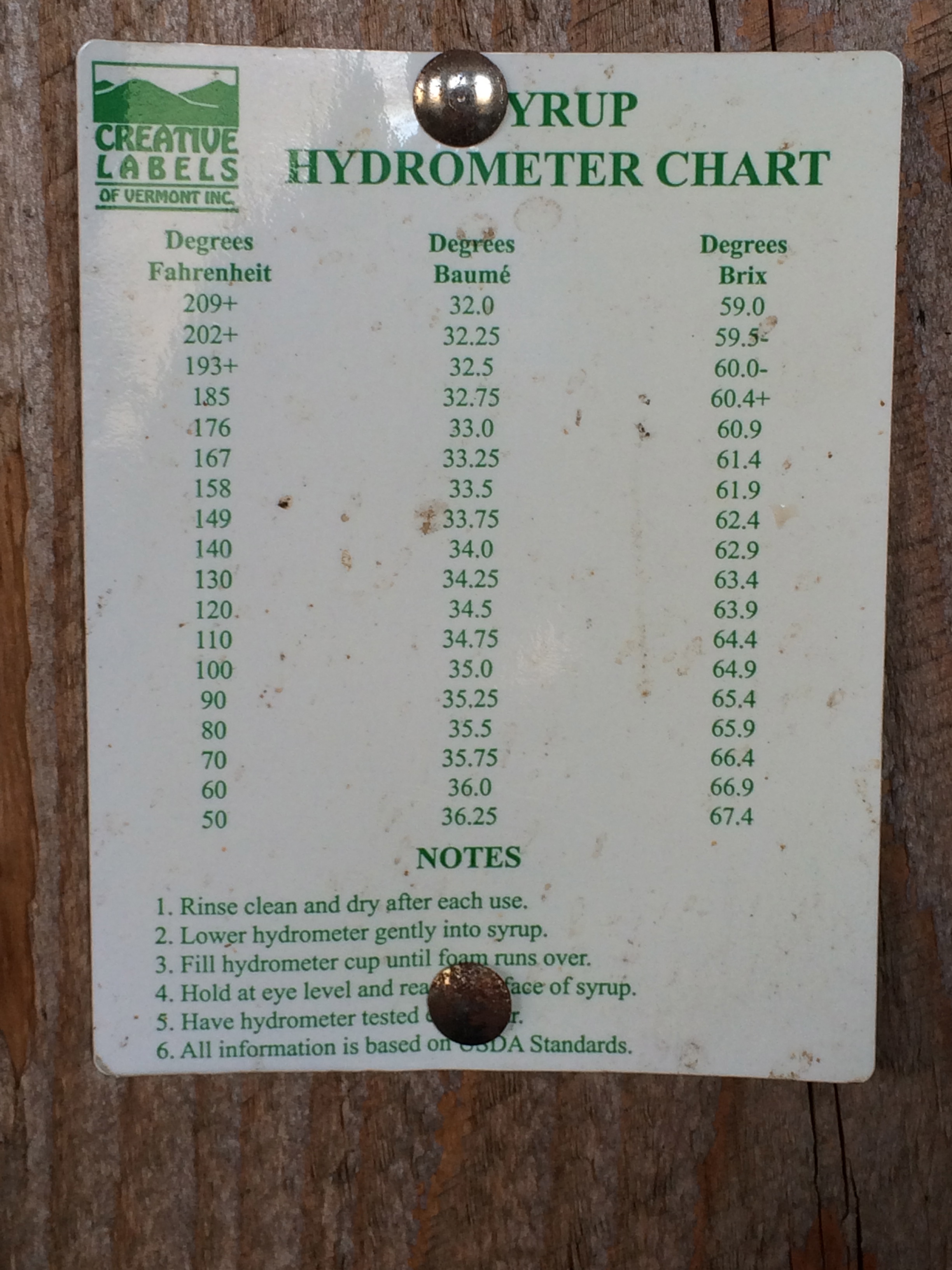
Strictly speaking, though the temperature at which sap becomes syrup changes depending upon barometric pressure and elevation from sea level, the density is constant at a given temperature. (Ex. – syrup will always be 32 degrees Baume, at 211 degrees F. However, as temperature changes so does the density.)
A hydrometer chart is key, as it includes the proper temperature conversions for the Baume scale:
Filtration is the final step in the process:
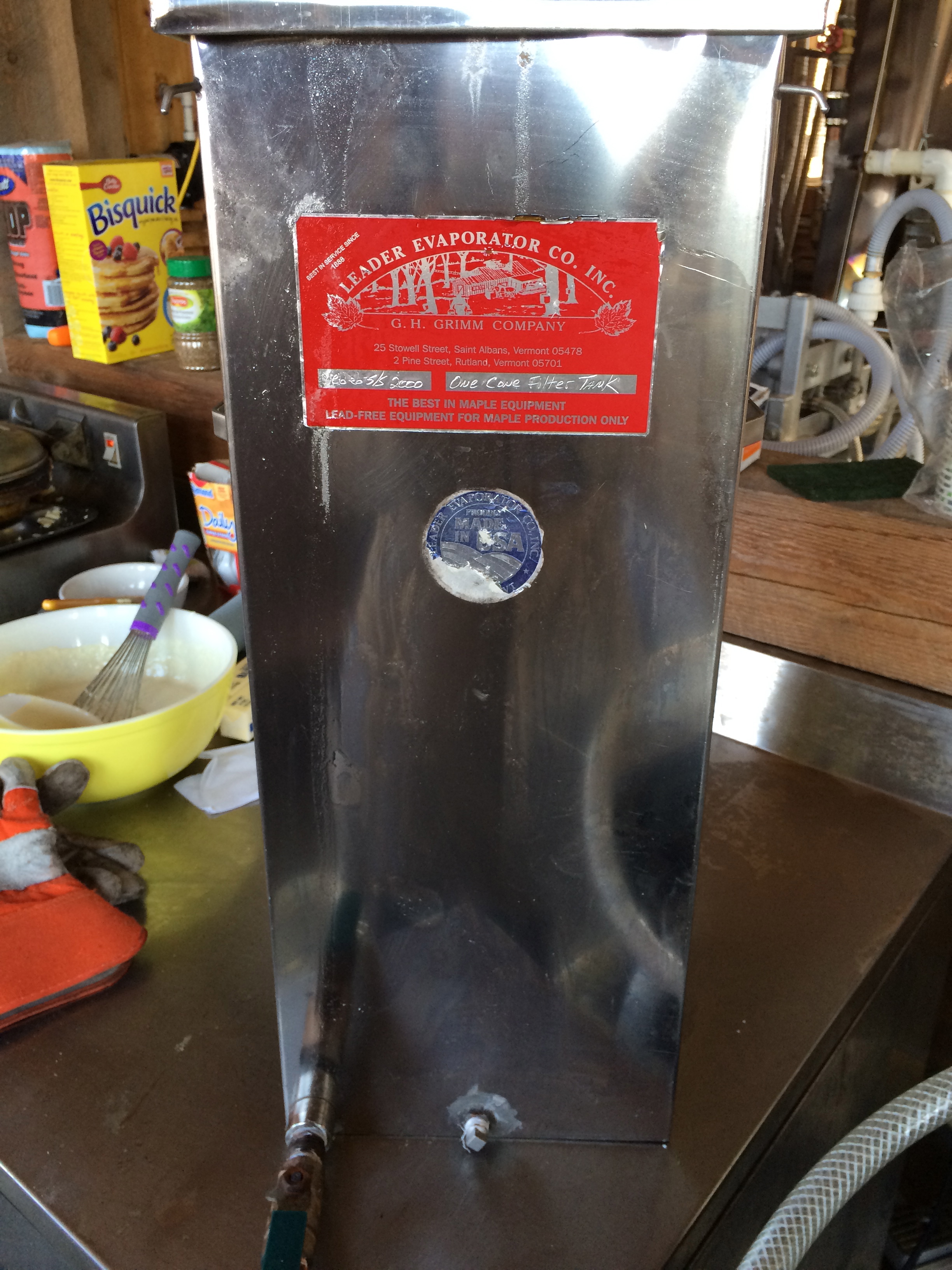
Filter tank
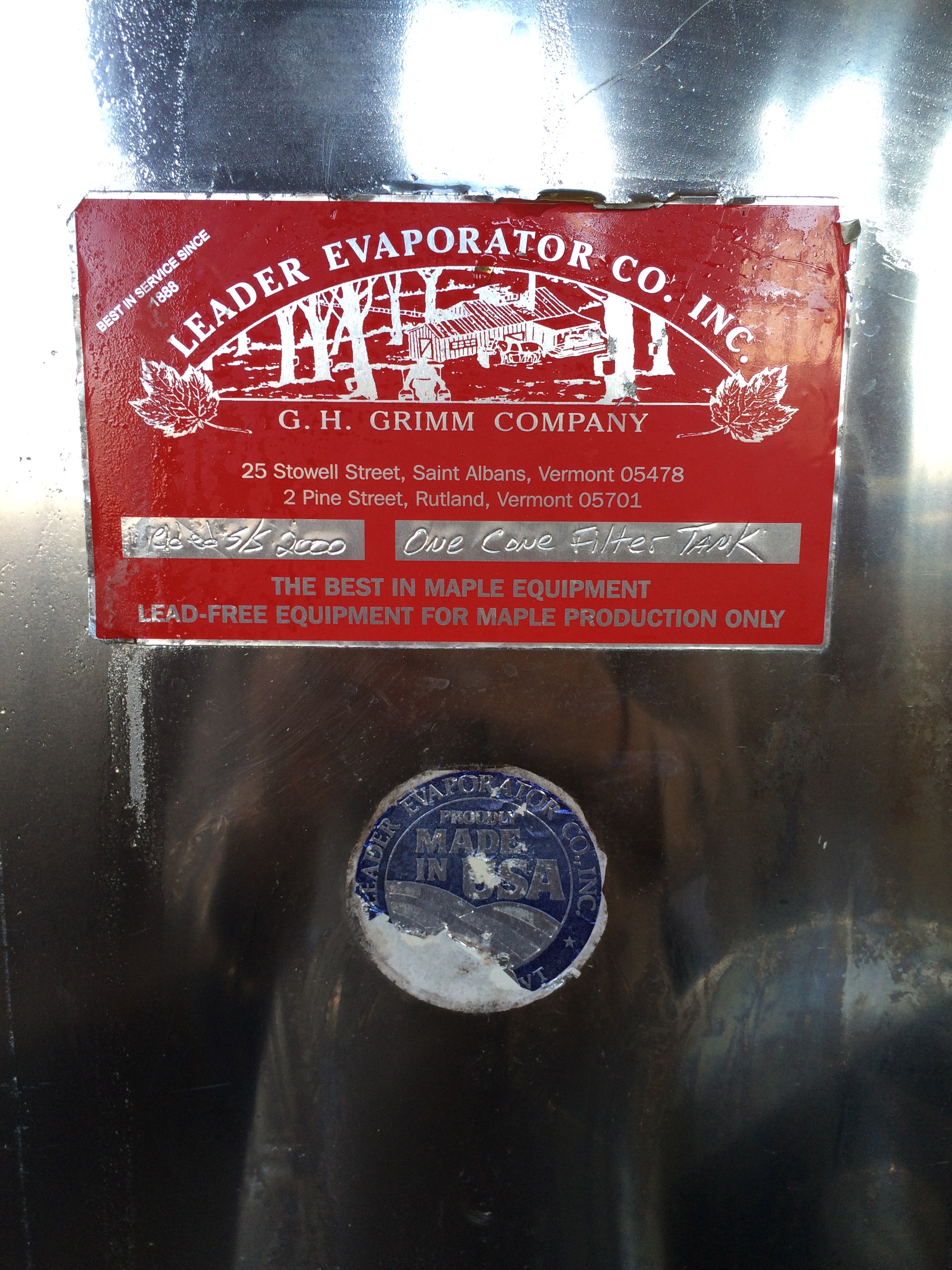
G.H. Grimm Company – formerly of Rutland, VT

A filter press transfers the final product to a lined pan.
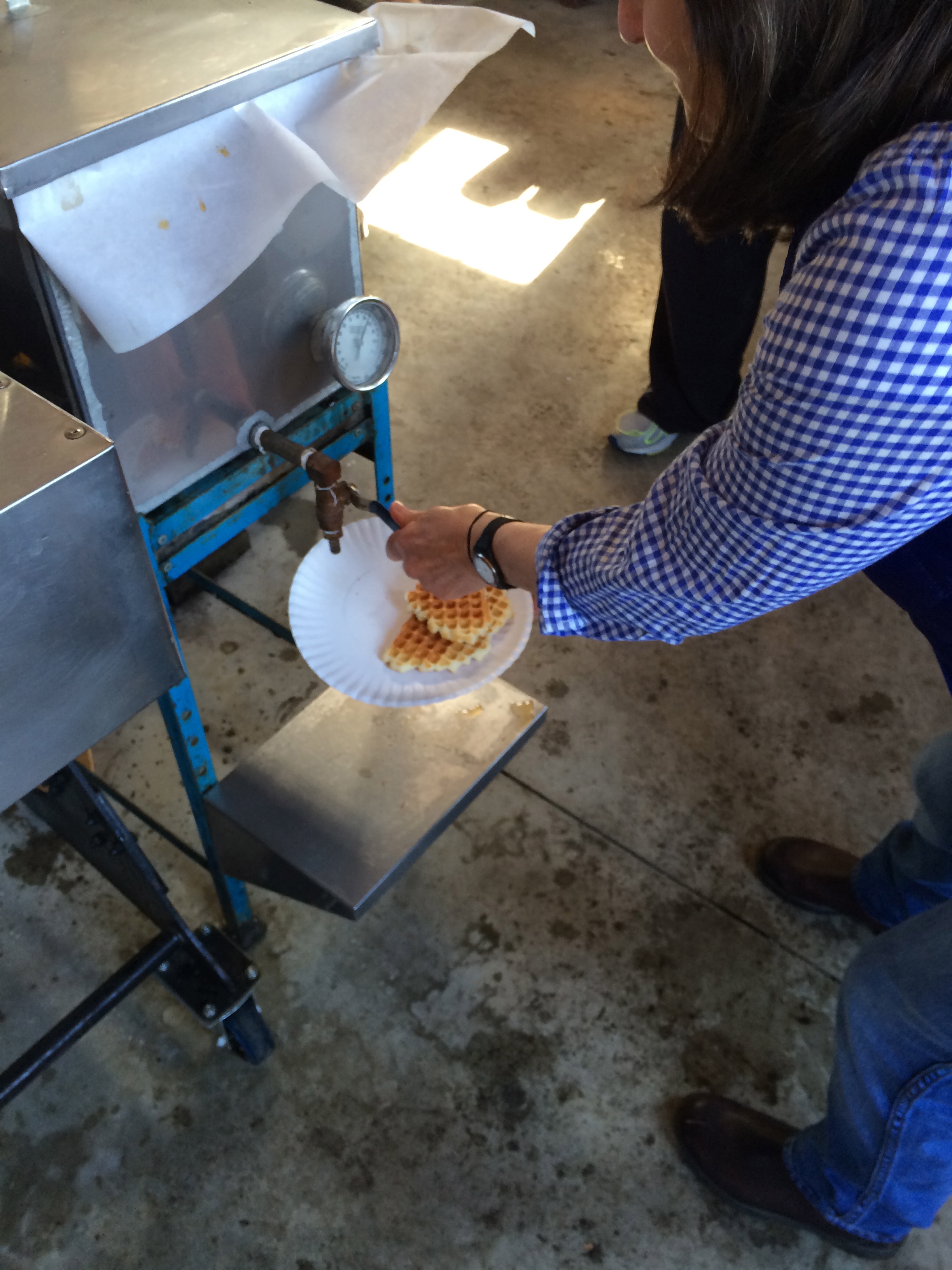
The filtration process takes about 15 minutes using this equipment. There is plenty to do during the wait:
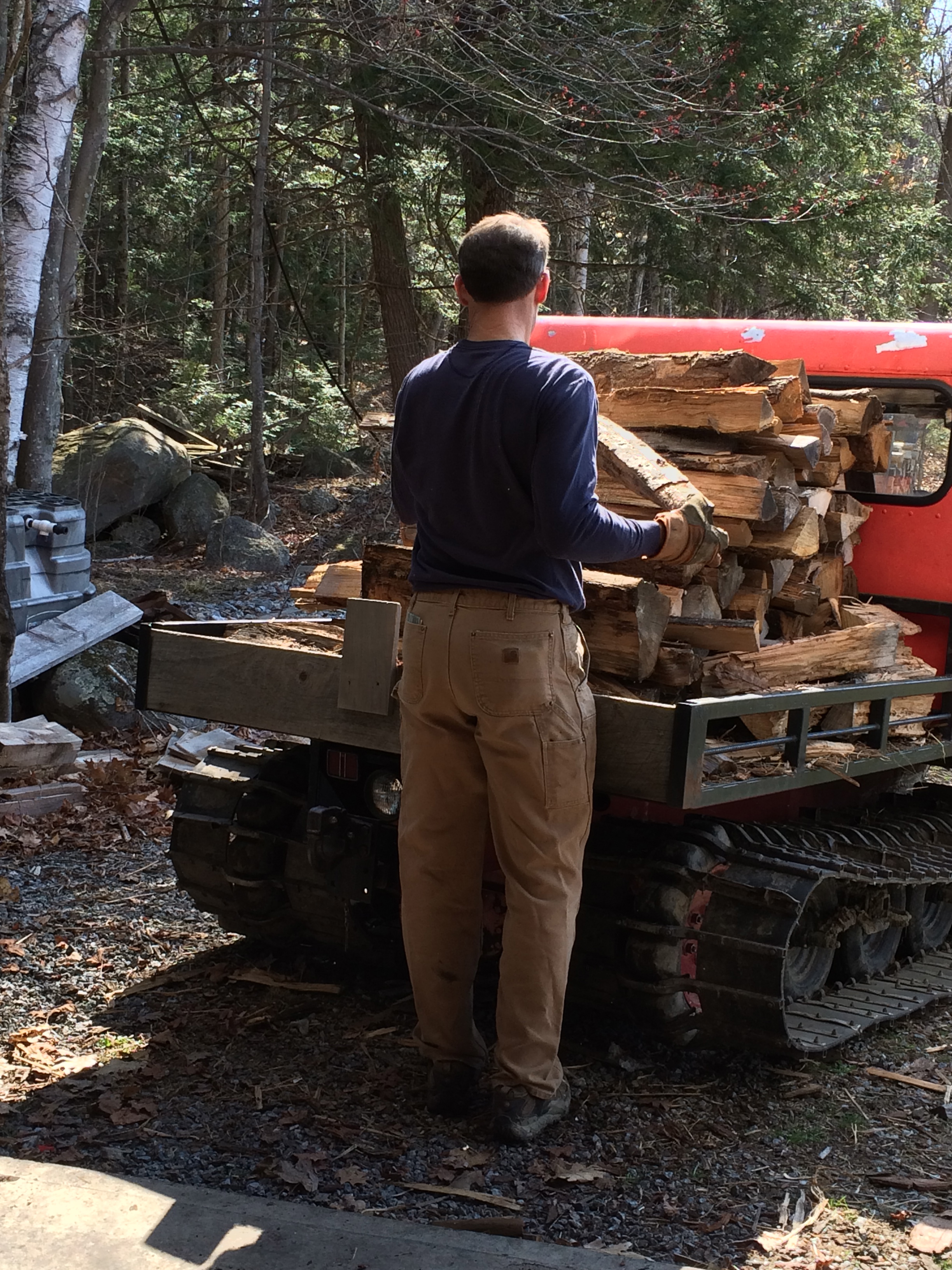
Replenishing the wood stove

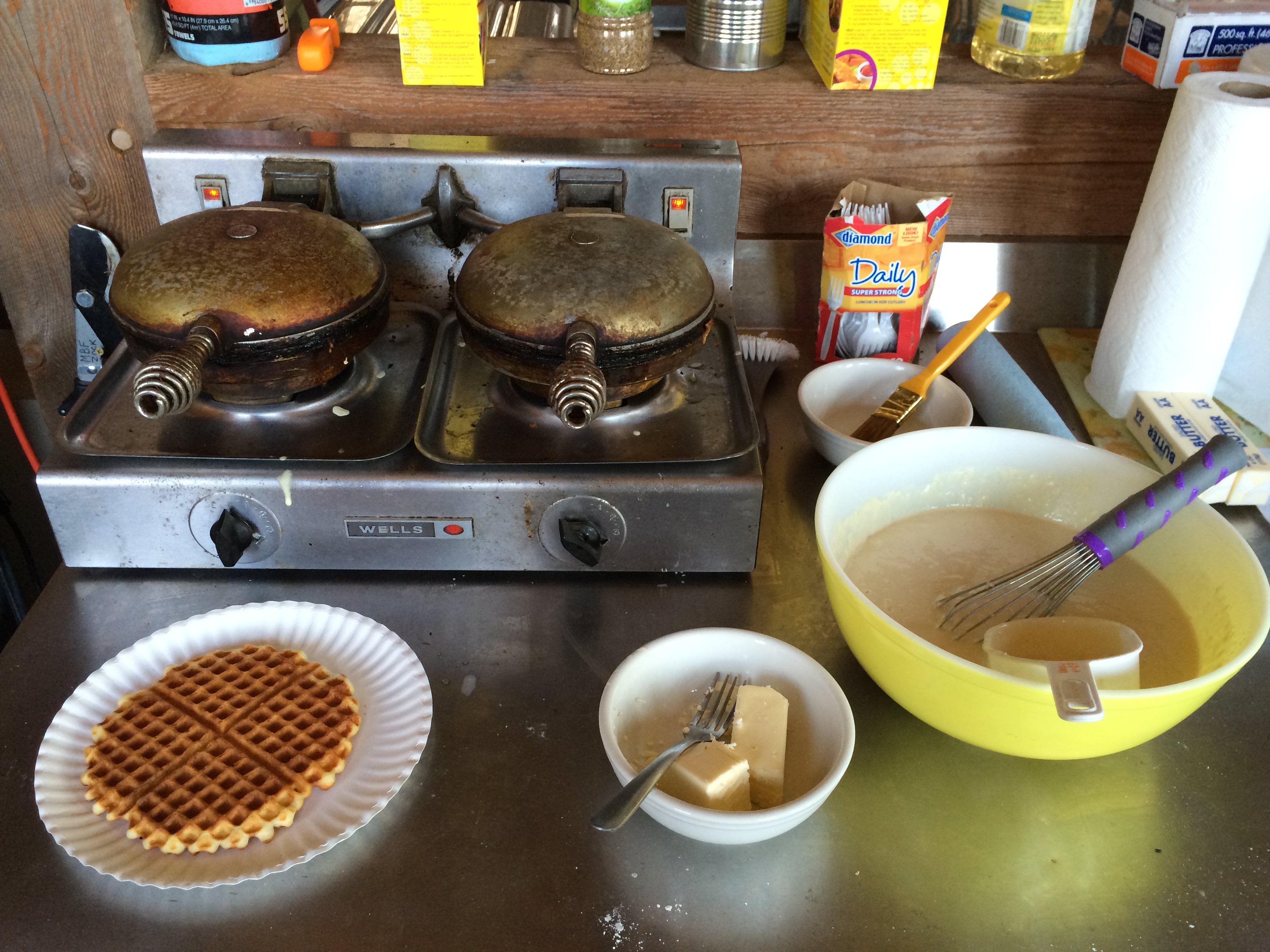
Preparing waffles


Admiring the view
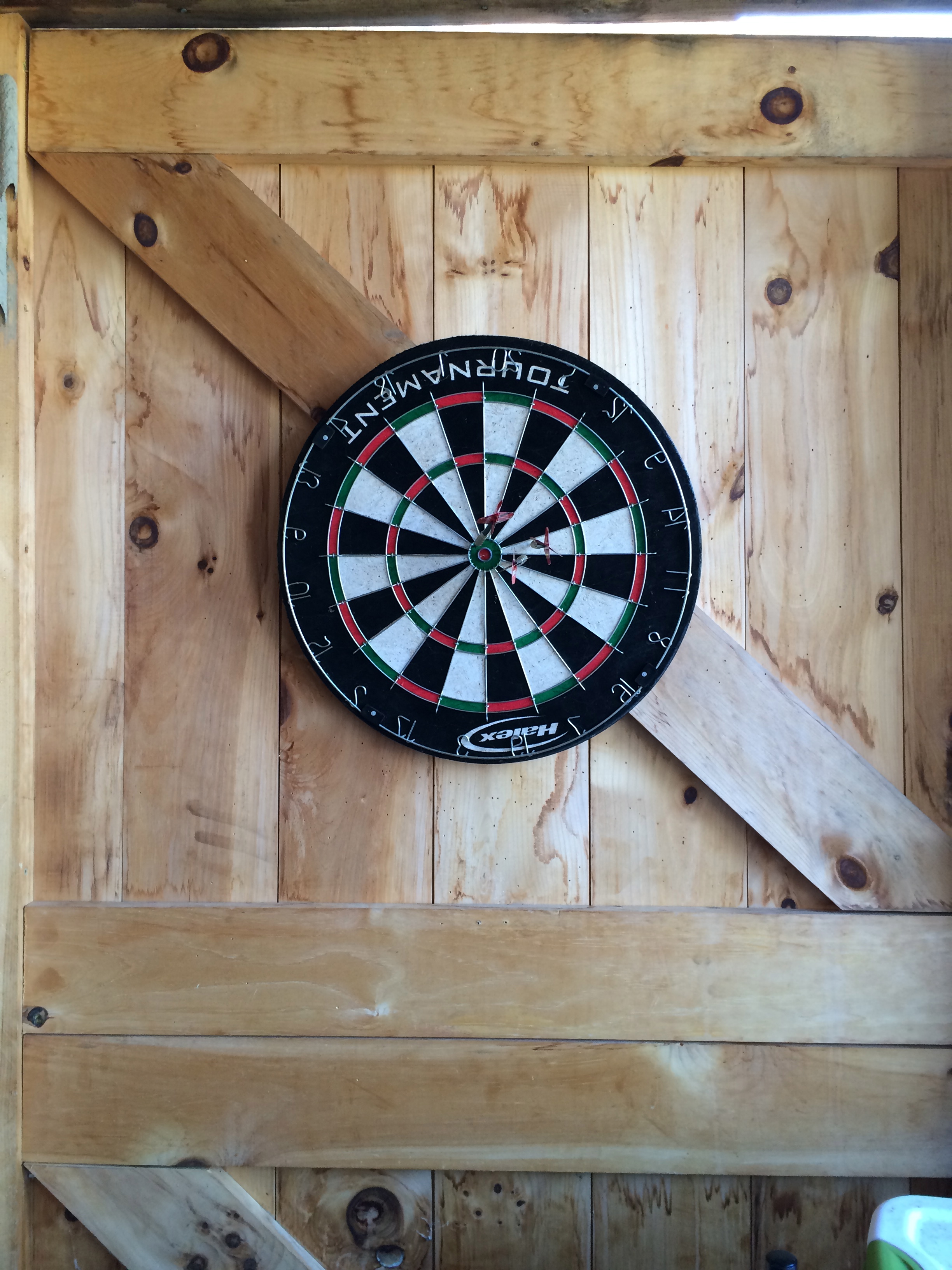
Darts, anyone?
The syrup is finally ready for a test taste:
And bottling:

Cases ready for bottling.
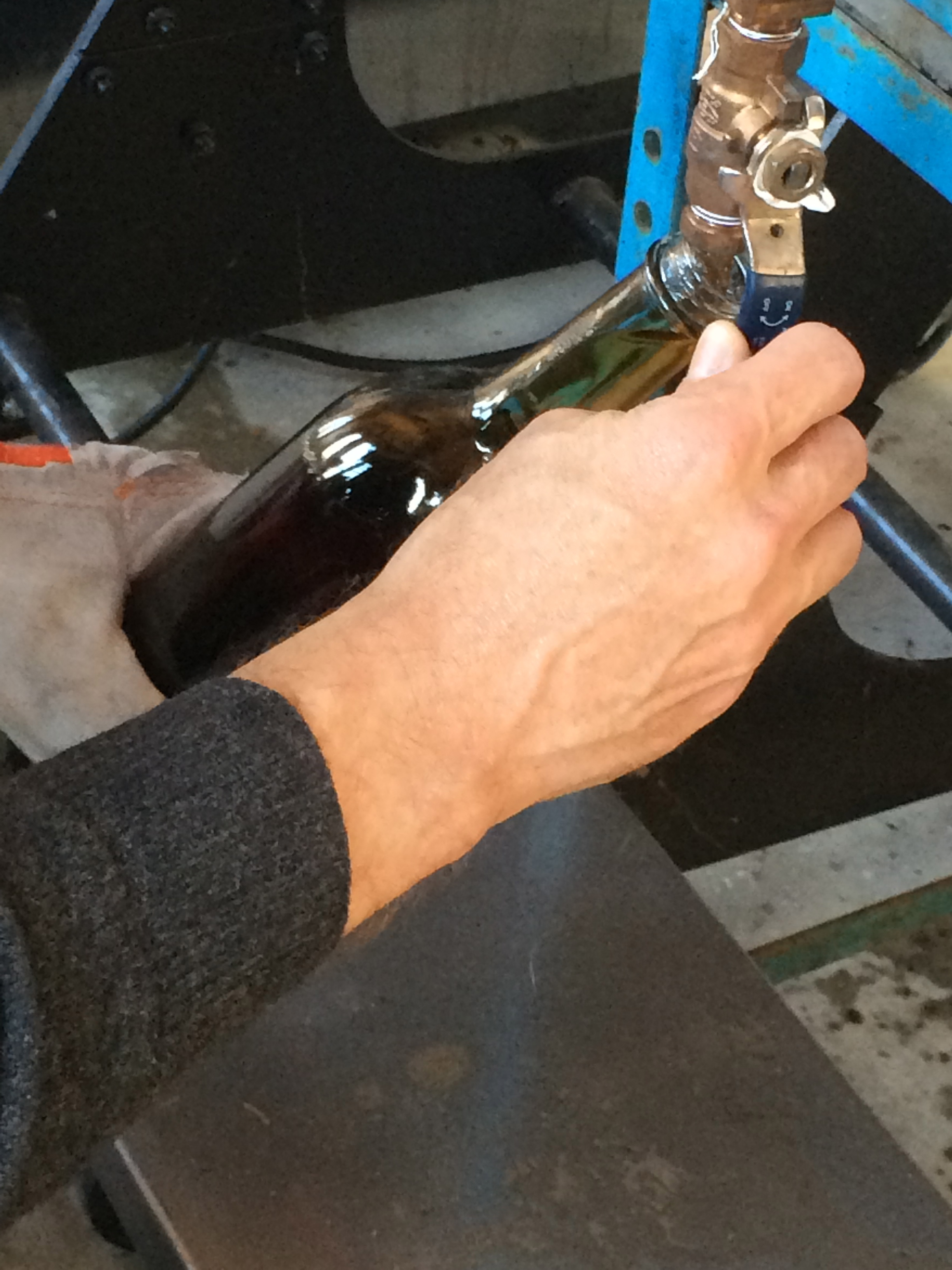
10 gallons (60 bottles) is the yield for the day. It takes roughly 50 gallons of sap to produce one gallon of syrup.
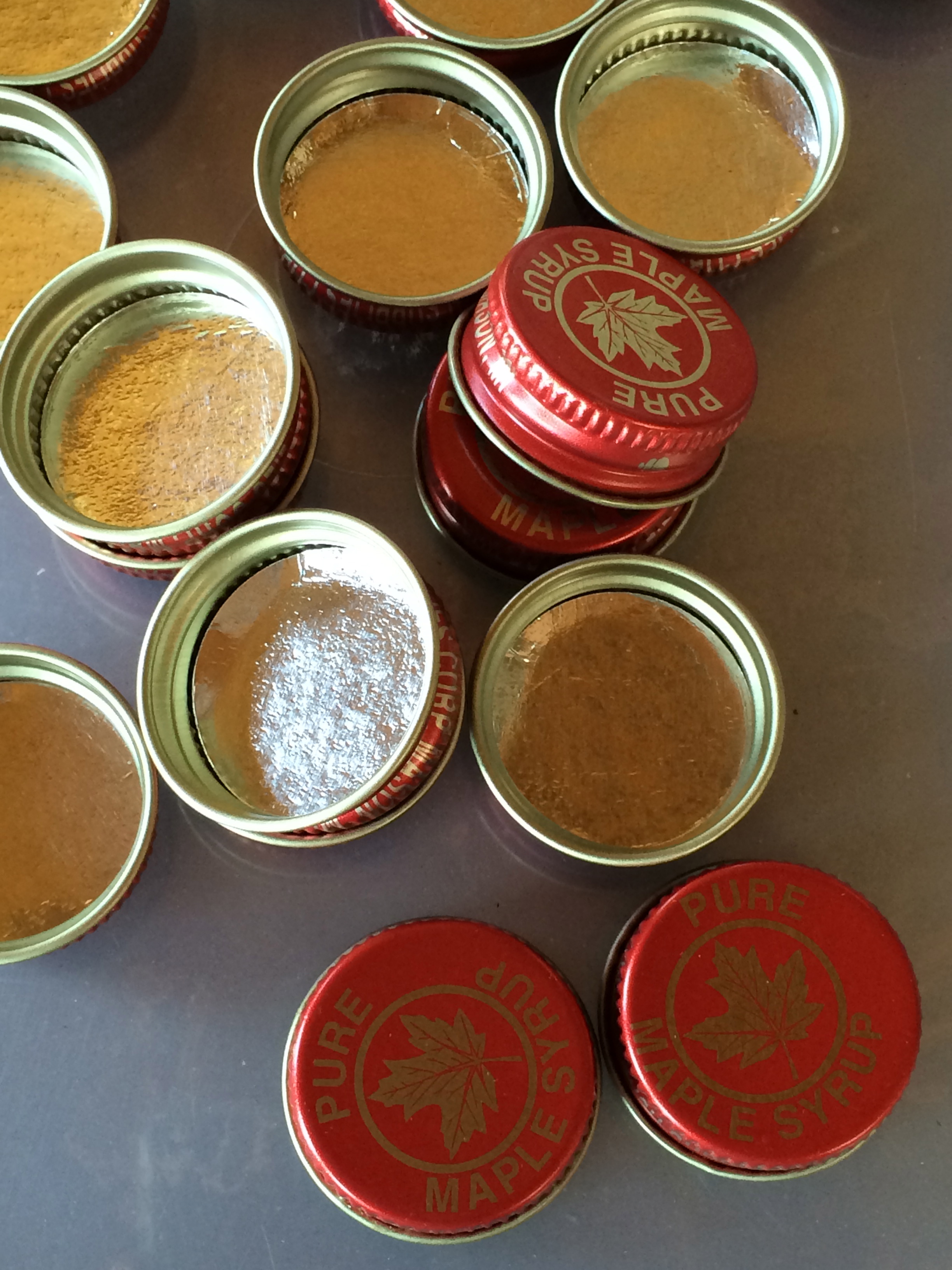

Once filled, the glass bottles are stored upside down to ensure a proper seal.
Shelves lined with small bottles from prior years of production serve as a guide for syrup grading:
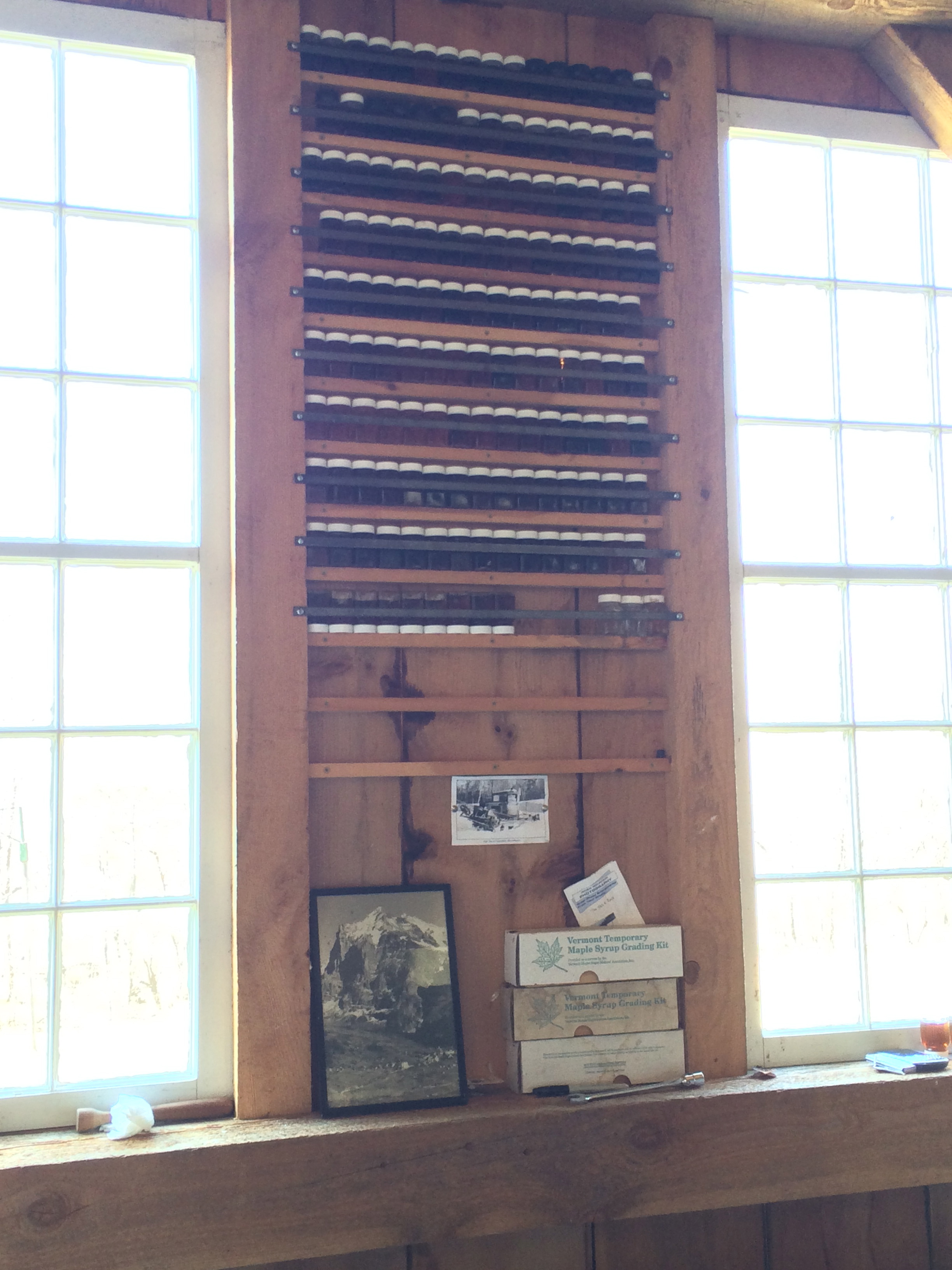
For more information on the grading system: http://www.nhmapleproducers.com/how-to-make-maple-syrup/maple-syrup-grades/
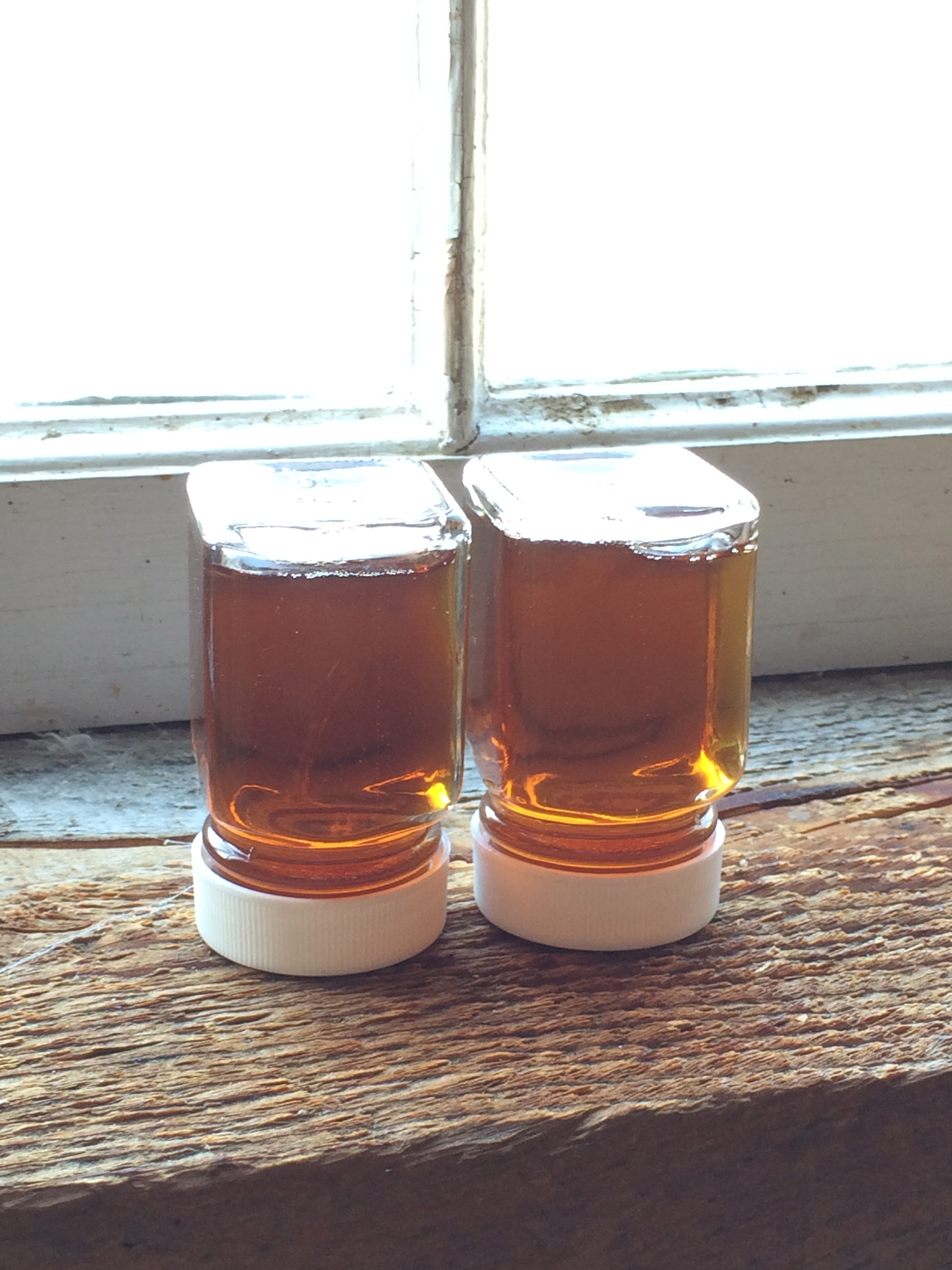
An outstanding specimen:

I left with one bottle and placed several more on reserve for friends and family. Pancakes and waffles are a certainty in the very near future!
For more information about Stone Ridge Farm and CSA shares:
http://www.stoneridgeorganics.com
http://localharvestnh.com/index.php/the-farms/stoneridge-farm/
http://www.americantowns.com/nh/bradford/organization/stoneridge-farm


Maple syrup is my favorite of all NH crops. This is the only time I allow myself to eat pancakes morning, noon and night!
LikeLike
Agreed. Exercising restraint was a bit of a challenge amidst the temptation of so much sweet, syrupy goodness!
LikeLike
Ahhh……Sweet delicious pancakes and maple syrup!!!
LikeLike