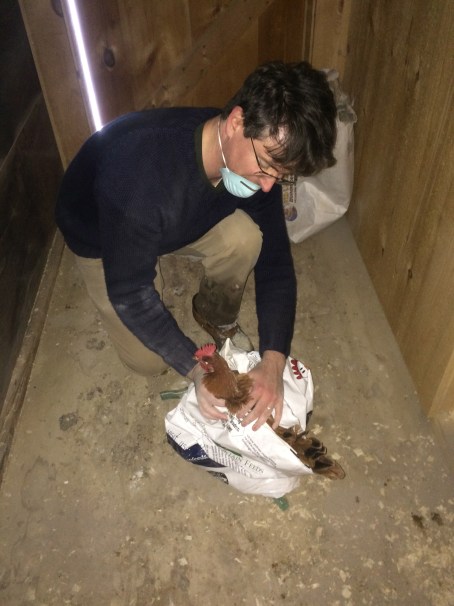
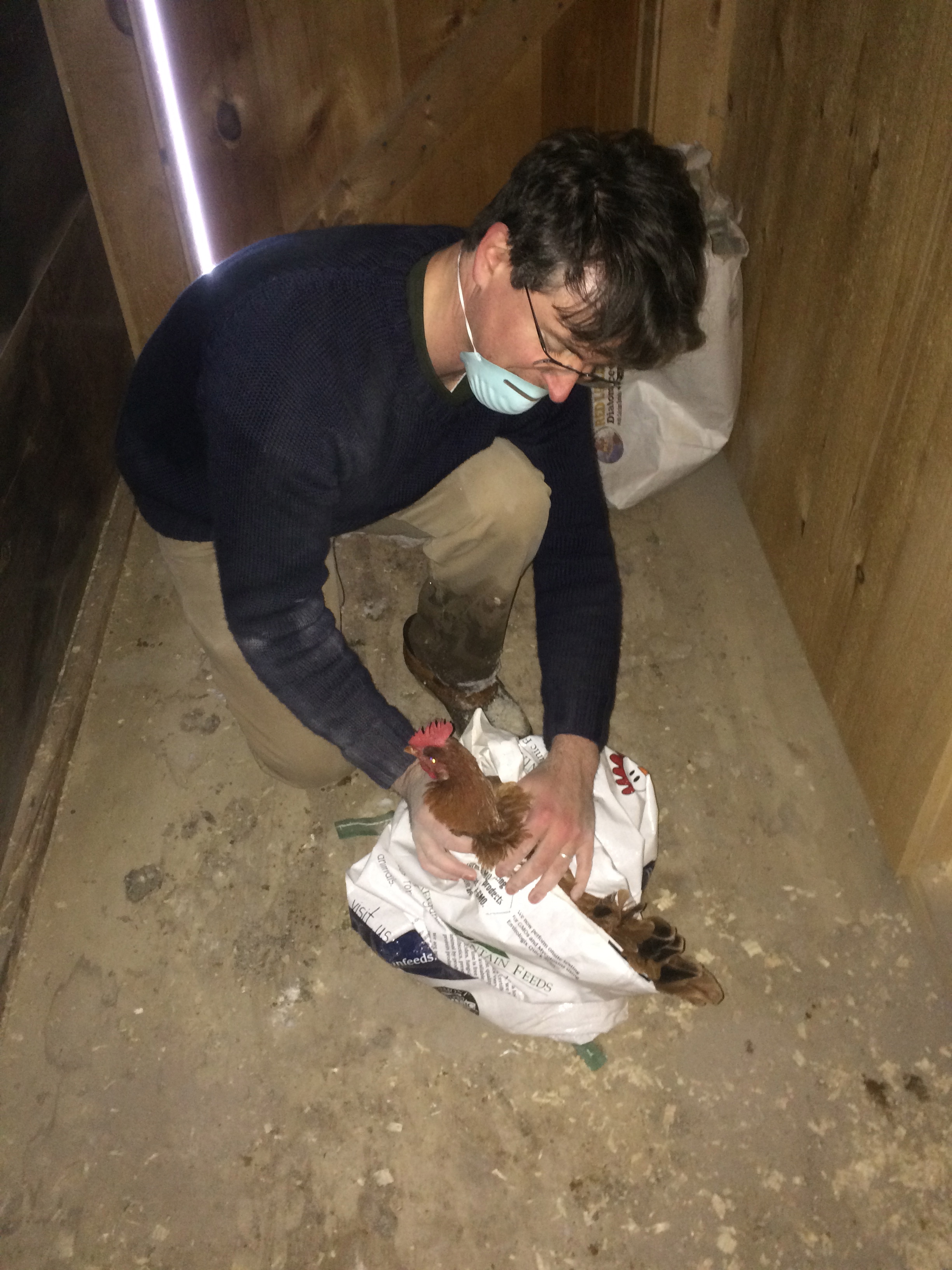
One of our hens being immersed in a diatomaceous earth bath
(Note: the following was posted retroactively, having actually occurred the day before Thanksgiving, 2014)
As with any endeavor involving farm animals, one is bound to run into health issues both minor and otherwise. The expert anticipates and plans for such occurrences, while the uninitiated must learn the hard way through experience. The latter was one of those occasions in our case.
It was to be the last warm day of the season and I thought we’d give the chickens one final romp though the great outdoors before being cooped up for the winter. They collectively leapt at the opportunity and were out the door to freedom as soon as it was opened. A lone hen lingered behind, idling listlessly by one of the feeders. Closer observation confirmed that something was clearly wrong. With some help from my husband, we gathered up the hen, placed it in a medium sized box with fresh pine wood shavings and took a trip to Concord Area Veterinary Emergency Services (CAVES). Casually glancing around the waiting room, I made what can be confidently categorized as one of the more unwelcome discoveries had to date. There on the flaps of the box were crawling hordes of pin head sized creatures, seemingly gaining in mass by the moment. Having no idea how I’d not noticed them earlier, I then looked down and could see plainly that they were also all over my hands, wrists and jacket. Unfortunately, having something of an insect phobia (a curse that befell me at a very young age and not at all advantageous to life in the country), I entered into a mild state of what might best be described as barely functional revulsion. A young girl came in shortly thereafter and sizing up the situation, informed me that these nearly microscopic harbingers of death were in fact mites – most probably northern fowl mites to be exact – and that furthermore, it is not at all uncommon to find them lurking about in the chicken coop. The root cause for their most objectionable arrival could be any number of reasons. The important thing, she said, was that the entire coop (as well as the birds) needed to be sterilized from top to bottom in order to be rid of the problem. The vet on call arrived, assessed the bird and summarily informed me that while surgery was an option, euthanasia was really the most humane course of action given the circumstances. (*) The diseased bird was a good deal past saving and even surgery offered very slim chances for its survival. Quite embarrassingly, my eyes began to well up a bit at this news. Further to my embarrassment, I realized about half way through the visit that the vet on call was none other than the husband of a woman I’d met through friends at a dinner a few months ago. Possibly half the town might soon know that I’d been visibly distraught over a chicken by the end of the week. (In defense, my husband and I are vegetarians and while we do eat the eggs produced, the chickens themselves are more like pets to us than anything else so it was somewhat of an emotional reaction on my part).
Several tissues (for the mites, not the tears) and one less chicken later, I emerged rather dejectedly from the vet’s office. It was on the drive back that I began to mull over the next steps in earnest. There had been talk of needing to clean out the coop as well as the birds. Ray Clarke, our half-year round groundskeeper had left for Florida in mid-October and wouldn’t be returning until next May, so no help could be expected on that front. My husband had work meetings to attend and it dawned on me that the bulk of this clean-up business was going to fall entirely to me. Given the forecasted snowstorm for the following (Thanksgiving) day, the task was impossible to put off for even a very short length of time. Though not unfamiliar with coop cleaning as a part of regular maintenance, this mite infestation fell into an entirely different category. I stopped in at the local farm and country store for supplies as well as advice from one of the girls who works there. As expected, she not only knew what to do but was also thoroughly acquainted with the process, having been through it several times with 400 of her sister’s own birds. Her instructions were to shovel out the entire coop, scrub it from top to bottom with bleach and boiling water and apply a generous dusting of diatomaceous earth over all surface areas, including nesting boxes and perches. A fresh bed of pine shavings would then need be applied but no more than 3-6 inches was necessary. (I had read earlier that a full 10-12 inches was recommended, per “Story’s Guide to Raising Chickens” but she begged to differ.) The coop cleaning itself would take at least 6 hours by my calculations. But there was the matter of the birds themselves. Each would require a diatomaceous earth “bath” before being returned to the coop. Simply put, each bird was to be placed into a bag roughly one third full of diatomaceous earth, turned upside down and shaken – the idea being that the shaking itself would generate the right amount of dusting to cover the entire surface area of the bird, ensuring that the mites in turn would receive the appropriately lethal dose of the dust. And now, dear readers, you understand the meaning of the phrase “shake and bake” in this context (or more appropriately “shake, no bake” as one woman in town correctly pointed out. ).
I slogged through the unglamorous chore of purging the coop of its used wood shavings and deposited them by the cartload into the woods behind our house. Dusk was approaching and the shake and bake itself had to wait until the following day. The chickens, meanwhile, were temporary boarders in the guinea hen coop while their own housing was being decontaminated. They had remained there overnight as well, since it made little sense to put contaminated chickens into a now sterilized coop. What the guinea hens thought of this arrangement is impossible to say but little seemed out of the ordinary the next morning when my husband and I went in to check on them. We determined that all was well and it was time to prepare the dust bath. It is advisable to wear dust masks, eye protection and gloves for such a task as the inhalation of the dust is irritating to the nose, eyes and nasal passages. Diatomaceous earth works by absorbing the oils and fats from the cuticle of the insect’s exoskeleton, causing insects – mites, in our case – to dry out and die. Its sharp edges are abrasive, thereby speeding up the process and it remains effective as long as it is kept dry and undisturbed. The earth itself is made from the fossilized remains of tiny, aquatic organisms called diatoms. Their skeletons consist of a natural substance called silica. Over a long period of time, diatoms accumulate in the sediment of rivers, streams, lakes, and oceans. Today, silica deposits are mined from these areas.
The most challenging aspect of the dust bath was getting hold of the chickens themselves. They were still lodged with the guinea hens, who by nature are more high strung. This made the task even more of a challenge than it would normally have been. The scene was something like this: door to coop opens, guinea hen screeching and flapping about commences, chickens simultaneously disperse and make a run for it in all directions, wood chips and feathers fly and the would-be bird catcher stumbles around with arms outstretched, trying desperately to get hold of a bird – any bird. Admittedly and as I later learned, there are easier ways to go about the job but neophytes as we were, did not realize it at the time. One by one we did manage to get each bird out of the guinea hen coop into the waiting dust bath and then returned to it’s own coop. Deviating a bit from the advice given to hold the birds upside down in the bath, we instead held them upright. I found that holding the birds sideways after securing them did calm them down considerably – even the roosters, which were more difficult to deal with as compared to the hens. After about an hour or so, the last chicken was dusted and so were we. Covered in a light film of grime, we walked through the barn back into the house. The shake and bake was a success. No sign of the mites could be found as little as one week later and they have not returned since.
(*) A few days after, a friend of mine and I were doing some in-town Christmas decorating. During conversation I happened to mention the unfortunate chicken incident. We were at the local lumber store picking up supplies and the clerks there expressed incredulity at hearing the story. “You mean, you had to have the chicken put down, right?” one of them had asked. “No”, my friend corrected. “She had it put to sleep – at the vet’s”. After a momentary blank stare they remembered that I was originally from out of town and a good laugh was had by all – including me.
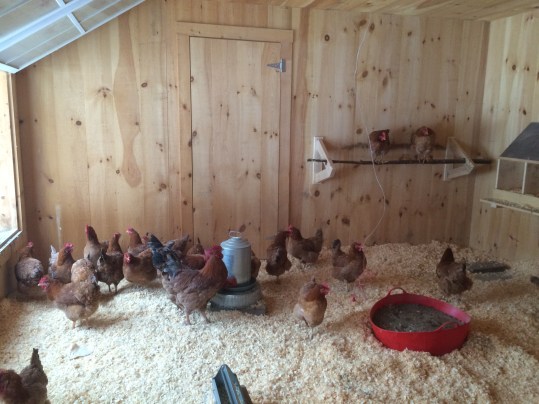
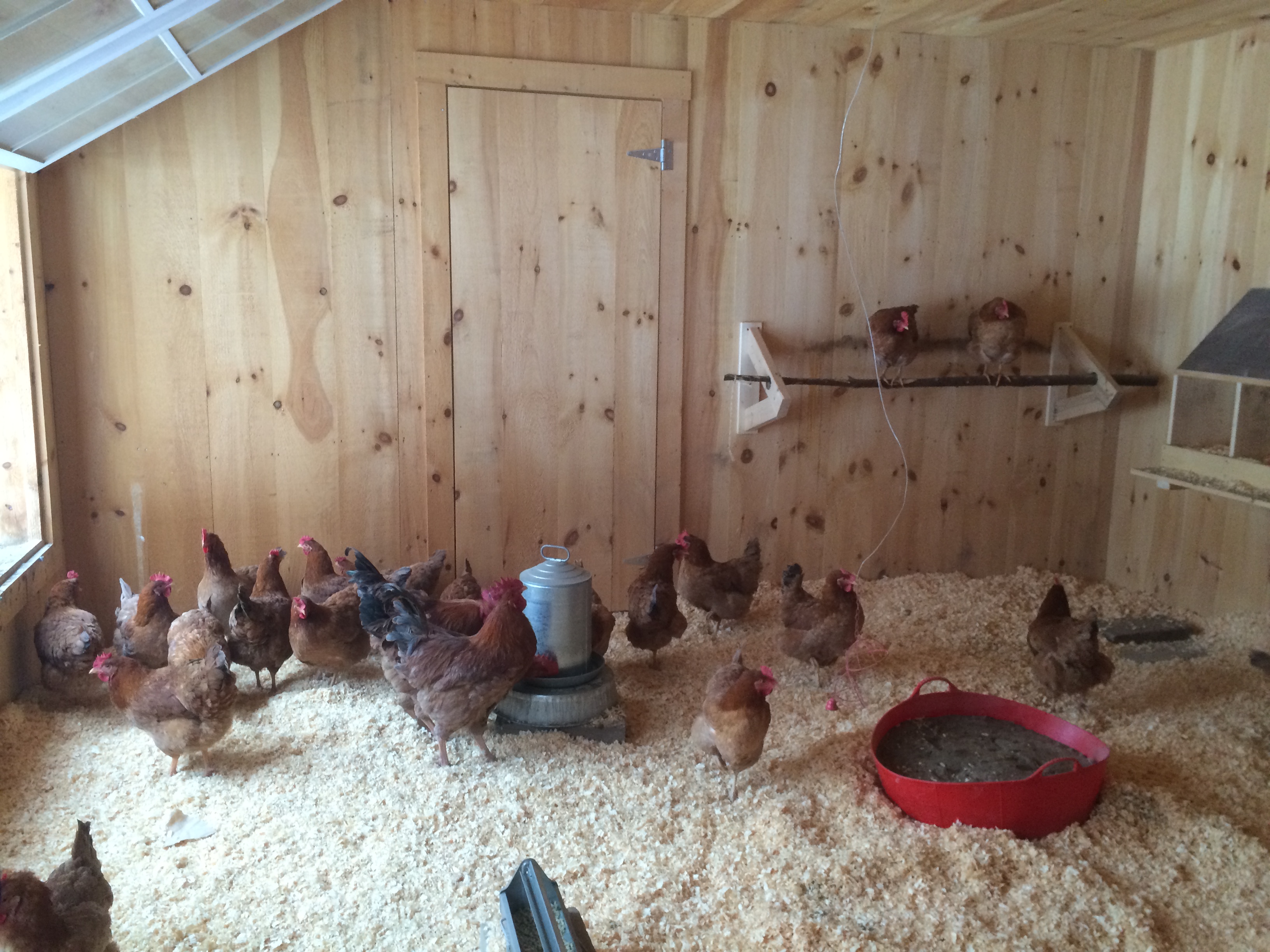
The coop, post clean-up. The red bin pictured is a make-shift dust bath, containing a mixture of dry soil and diatomaceous earth. This will help to curtail the development of any future external parasites.























 Rural New Hampshire